2019 Ford Ranger 4x4 Look And Feel
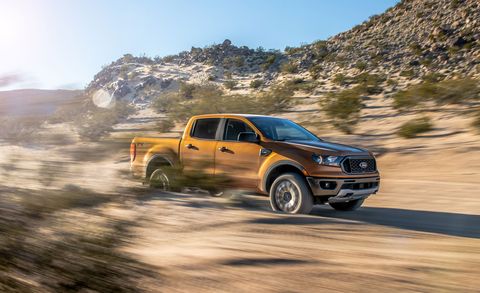
Driving a pickup changes your point of view and, therefore, your attitude toward driving. Some portion of it is that the truck is somewhat of an outfit—a cowpoke cap and a Western shirt. But at the same time it's that pickups are worked to pull, not deal with. From the pilot's roost in the new Ford Ranger, the street goes by some place path down there, entire feet beneath your toes. The suspension, casing, body, and even the seat work to numb away the passing black-top.
Minimal in excess of a smooth murmur advances into the lodge. We gauged 68 decibels at 70 mph and a satisfying 76-decibel snarl with the quickening agent straightened. Observers will hear a whistling turbo, however beside some nearly diesel-like injector bang, very little achieves the inside. The turbocharged 2.3-liter four-chamber stays away as the 10-speed programmed keeps the revs low. It's alleviating up here, notwithstanding some discontinuous disturbance from the autonomous front and live back axles' responses to breaks and hindrances.
Maybe it's the rough terrain centered FX4 suspension that is at fault for the periodic shivers that irritate the harmony. A $1295 choice accessible just on 4x4 models like our Ranger XLT, the FX4 bundle changes the damper tuning and includes rough terrain tires, a locking back differential, slide plates, tow snares, Trail Control, and the Terrain Management System, which enables the driver to tailor the throttle and transmission reaction to four distinct situations. This is a decent spot to specify that Ford isn't putting forth us a Ranger Raptor yet—it's as of now accessible outside our market. This appears to be an oversight on the dimension of Jeep holding up a long time to present a four-entryway Wrangler or Ford itself taking a very long time to convey this Ranger to the U.S. After such a long pause, and dependent on the runaway accomplishment of the F-150 Raptor, Ford should pick up the pace and bring over the Ranger Raptor, which will probably be the most attractive—and beneficial—form of the truck on our shores.
That is anything but a Raptor didn't prevent us from climbing desert slopes and playing in the sand. We can infer that the FX4 Ranger will go more remote rough terrain than most people will set out. Despite the fact that the FX4 suspension doesn't raise the 4x4 Ranger's ride tallness, its standard 8.9 creeps of ground freedom and the rough terrain bundle's slip plates—Ford considers the front one a "slam plate," which is amazing—make trail work and rock bumping simple. The low maintenance four-wheel-drive framework for all time bolts the front and back axles together in 4 High and 4 Low, and a catch in front of the shifter bolts the back differential. Footing control utilizes the brakes to keep the front diff from turning the tire with the least hold. To make creeping and holding a low speed simple, Trail Control goes about as a kind of rough terrain voyage control, utilizing the motor and brakes to keep the Ranger at a preset speed without the driver contacting the pedals. None of these highlights are very as valuable as the one that Ford doesn't offer, however. An asphalt agreeable auto mode, similar to the one accessible in the Chevy Colorado, would permit the exchange case to carry on like an all-wheel-drive focus diff, perfect for on-street terrible climate conditions.
Back on solid, makes and knocks use laugh hysterically the FX4 suspension's underlying consistence and uncover a hardened suspension and ride cruelty. Those effects send vibrations stirring through the edge, however the structure rapidly lessens them. On the off chance that you've driven a F-150 of late, the littler Ranger will appear to be promptly recognizable. Notwithstanding the firm ride and strong feel (for body-on-outline development, that is), you get drowsy, if exact, controlling reactions, a hard brake pedal, and a snappy moving 10-speed transmission.
When you work at a vehicle magazine, you now and again overlook what you're driving and toss a Ford Ranger into a progression of gulch corners. It's modestly engaging for a bit, yet then the longing to cut peaks and draw g's blurs, however our Ranger posted a better than average 0.78 g on the skidpad, which coordinates a 1992 Nissan Maxima SE. That may appear to be an odd information point, yet think about that the Maxima was showcased as the four-entryway sports vehicle. Is the Ranger the lifted four-entryway sports vehicle? Barely, yet drivers of old Rangers will be tossed by the associated control feel of the new truck. It'll appear as though it's from one more century, which is essentially valid.
Snared to the 10-speed programmed and in the engine of each new Ranger is the aforementioned turbocharged 2.3-liter inline-four. Identified with the turbo fours of the Mustang and the Focus RS, the motor makes less power here than it does in those autos. Be that as it may, the Ranger's 270 strength at 5500 rpm and 310 pound-feet of torque at 3000 rpm pushed this 4536-pound SuperCrew pickup to 60 mph in 6.5 seconds and through the quarter in 15.0 seconds at 93 mph. That is 0.4 second behind the V-6 Colorado and a tenth off the Honda Ridgeline's pace yet almost a second faster than a V-6 Toyota Tacoma. There's for all intents and purposes no slack from a stop, and the low-end torque inspires the Ranger absent much exertion. We didn't tow with it, yet we have almost certainly that this motor and transmission combo would have no main problem pulling close to the truck's 7500-pound tow limit. (Coming up short on the Trailer Tow bundle, our test truck was evaluated to pull 3500 pounds from its guard.) Compared with the six-chamber trucks it contends with, this present Ranger's city figure of 20 mpg is best in the class and its 24 on the roadway is 1 mpg short of the Ridgeline's and tied with the Colorado's. We just overseen 16 mpg amid our lift filled week with the Ranger. It's feasible you'll improve.
Driving more gradually than we do won't improve the inside. Exhausting and deadened in the way of a modest vehicle from 2011 (or a cutting edge Mitsubishi), the structure is in any event straightforward and the controls are anything but difficult to translate. Portage offers a 8.0-inch touchscreen, yet the lines, materials, and switchgear are straight out of Obama's first term. In any event the Ranger's lodge is a lot bigger than previously. In the new-to-this-gen SuperCrew design, there's a lot of room for four substantial grown-ups, and the back entryways open wide to permit simple passage. This Ranger is likewise 3.9 inches more extensive than the last back drive SuperCab demonstrate and 7.2 inches longer.
Like the inside, the outside structure is somewhat dull. However, the Ranger isn't attempting to be something it's not or play up its truckiness the way full-measure pickups do. There isn't a hostile measure of chrome decorating our test truck, no endeavor to make it resemble a Class 8 tractor, and the ornamentation isn't attempting to win an identification estimating challenge. We noticed some spotty board fits where the hood meets the bumpers, and the hole between the bed dividers and the back end is sufficiently substantial to see through. SuperCrew models, with their four full-estimate entryways, accompany a bed that is a little more than five feet long, while the SuperCab, with littler half entryways, has a six-foot, three-quarter-inch bed. The bed of our SuperCrew 4x4 can hold 1560 pounds of quills, or lead, or water, should you need to make your Ranger into a portable hot tub. That is not exactly 50% of what some F-150s will pull, which conveys us to how the Ranger will fit into a world overwhelmed by the F-150.
A base back drive Ranger begins at $25,495, and a SuperCrew 4x4 opens at $31,875. Pick our truck's XLT trim and that hops to $35,310. Alternatives brought our aggregate to $41,725, a value that does exclude calfskin and would place you into a pleasantly prepared F-150. Huge impetuses on full-measure pickups and merchants spurred to move F-150s may hurt Ranger deals, yet that is valid for all moderate size trucks, but then the section is developing. Toyota sold almost a quarter-million Tacomas a year ago, Colorado and Canyon deals were barely short of 170,000, and Nissan verged on moving 80,000 Frontiers—which is momentous considering the Frontier cell based dates to 2005. Despite the fact that this Ranger isn't entirely new, medium size pickup purchasers are obviously an easy-going part. The new motor and transmission, calm on-street mien, and marginally increasingly sensible size ought to enable the Ranger to flourish in the shadow of the F-150.
Comments
Post a Comment